.png)
We Paint to Restore Your Home.
We Work to Earn Your Trust.

Wood Restoration
-
Expert care to revive and protect weathered wood
-
Custom stains and sealants for lasting beauty
-
Passionate craftsmanship with an artist’s touch
My philosophy
Restoring wood is about honoring its natural character while protecting it for the future. It’s where craftsmanship and care meet.
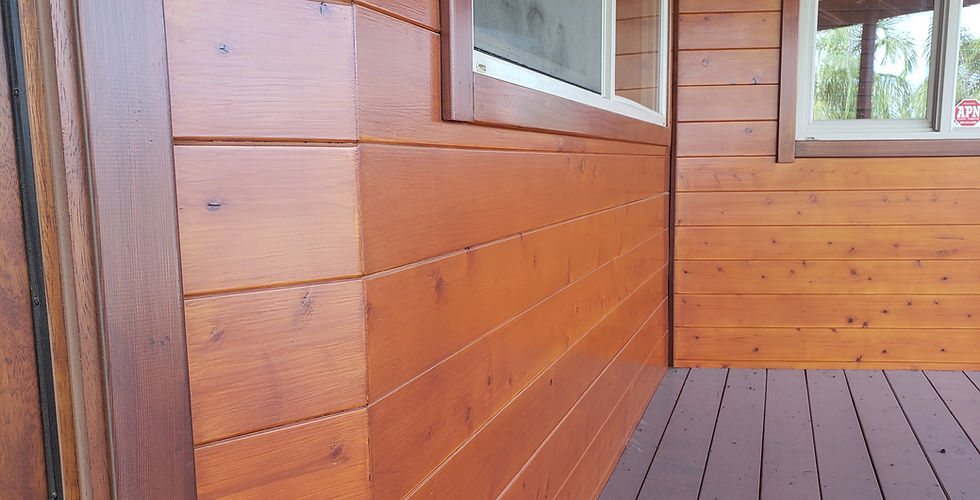
At Dan Gogh Paint Co., wood restoration is more than a service, it’s what we love most. We bring weathered decks, doors, railings, and trim back to life using a careful blend of technique and artistry. Hawaii’s humid climate demands extra protection, which is why we don’t just refinish wood, we strengthen it. From repairs and sanding to hand selecting the right stains and sealants, we make sure every project is both beautiful and built to last.
Watching the grain come through again and the richness return to the surface is a transformation we never get tired of. When you trust us with your woodwork, you’re getting the best of our experience and our passion.
]
Wood Restoration Services in Hilo
Hawaii is a place of extraordinary natural beauty — and nothing complements that beauty more naturally than well-maintained timber. Decks, railings, pergolas, exterior doors, window frames, and timber cladding are defining features of many Big Island homes. But Hawaii's climate is genuinely harsh on wood. The same conditions that make the island so lush and green — high humidity, intense UV, and frequent rainfall — are also the conditions that accelerate timber degradation most aggressively.
Wood restoration is the process of bringing weathered, greyed, or deteriorating timber back to a protected, finished condition — either restoring its natural appearance or giving it a fresh, coloured finish. At Dan Gogh Paint Co., we've developed precise wood restoration techniques specifically for Hawaii's Big Island climate, using professional-grade products that are proven in island conditions.
What Happens to Wood in Hawaii's Climate
Understanding why timber deteriorates in Hawaii's conditions helps explain why our specific restoration process is designed the way it is.
• UV degradation — Hawaii's intense UV radiation breaks down lignin, the natural polymer that gives timber its colour and structural integrity at the surface level. This causes the characteristic greying and surface checking (fine cracking) visible on unprotected timber
• Moisture cycling — Hawaii's wet-dry cycles cause timber to swell when wet and contract when dry. Over time, this constant movement causes paint and coating systems that aren't sufficiently flexible to crack and peel
• Biological growth — Mould, mildew, algae, and lichen grow rapidly on timber surfaces in Hawaii's humidity, particularly on the east side. Left untreated, these organisms actually degrade the timber surface itself, not just stain it
• Tannin bleed — Many Hawaiian hardwoods have high tannin content. Without proper priming and sealing, tannins can bleed through paint or stain coatings and cause discolouration
• Salt air corrosion — Coastal properties see accelerated deterioration of both timber and any metal fasteners, brackets, or hardware associated with timber structures
Our Wood Restoration Process — Step by Step
25. Assessment — We examine the condition of all timber surfaces to be restored, identify areas of active biological growth, UV damage, moisture damage, or previous coating failure, and advise on the appropriate restoration approach
26. Pressure washing — We pressure wash all surfaces to remove biological growth, loose existing coating, and surface contamination — calibrated to appropriate pressure for the timber species and condition
27. Wood brightening — A specialised wood brightener solution is applied to all surfaces after washing. This opens the wood grain, removes remaining grey oxidation, and restores the natural colour of the timber for optimal stain penetration
28. Drying time — We allow complete drying time after washing and brightening before any coating is applied. Applying stain or paint to damp timber is one of the most common causes of coating failure
29. Surface preparation — Any surface checking, splits, or damaged areas are addressed before coating. Loose or damaged timber is flagged for repair or replacement
30. First stain or coating coat — Penetrating stain or solid coating is applied as a first coat, worked fully into the grain by brush for maximum penetration and adhesion
31. Second coat — Second coat applied after appropriate drying time to build colour depth and film thickness
32. Third coat where required — On highly weathered surfaces or in exposed locations, a third coat is applied for maximum protection
33. Hardware treatment — All metal hardware associated with restored timber structures is inspected and treated for corrosion
34. Final inspection — Complete walkthrough with client to ensure satisfaction with the restored finish
Product Selection — Why We Use What We Use
At Dan Gogh Paint Co., we're specific about the products we use for wood restoration on the Big Island. Our primary specification for deck and exterior timber restoration is professional-grade oil-based penetrating stains — specifically Sikkens products where appropriate — for several important reasons:
• Penetrating vs. film-forming — Oil-based penetrating stains don't sit on the surface of the timber like paint. They penetrate into the grain, where they protect from within rather than forming a surface film that can crack, peel, or trap moisture beneath it
• Flexibility — Because penetrating stains move with the timber as it expands and contracts with Hawaii's humidity changes, they don't crack or peel the way surface coatings do
• Natural appearance — Penetrating stains enhance and complement the natural grain of the timber rather than obscuring it the way solid paints do
• Repairability — Worn areas of penetrating stain finish can be spot-treated without the full stripping and preparation required when a surface paint coating begins to fail
• UV resistance — Quality penetrating stains contain UV inhibitors that protect the lignin at the timber surface, significantly slowing the greying and degradation process